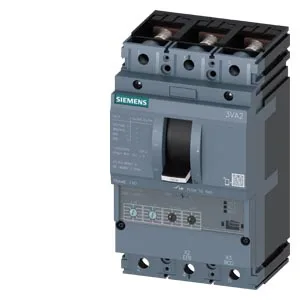
What this MCCB delivers and where it fits
The Siemens SENTRON 3VA2110-6HN32-0JC0 is a 3-pole molded case circuit breaker rated for 100 A continuous current, built for line protection duty in distribution panels and motor control centers. Its interrupting capacity hits 242 kA at 240 V and 187 kA at 415 V and 440 V — numbers that tell you this breaker clears high-fault scenarios without cascading upstream, which matters when you're coordinating a main or feeder in a plant with large transformer banks or multiple motor starters in parallel. The ETU350 electronic trip unit gives you adjustable long-time, short-time, instantaneous, and ground-fault protection curves, so you can dial in selectivity with downstream breakers rather than relying on a fixed thermal-magnetic curve. Rated insulation voltage is 800 V, and the breaker carries a shunt trip (STL) auxiliary release plus two high-quality auxiliary switches (HQ) pre-installed — that shunt trip lets you remotely trip the breaker from a safety circuit or a PLC output, which is standard practice on emergency-stop circuits or when you need to interlock a disconnect with a downstream VFD. No undervoltage release, no communication module, and no ground-fault monitoring fitted on this variant, so if you need those, you're looking at a different suffix in the 3VA2 family. Mounting is the standard SENTRON 3VA footprint — 105 mm wide, 181 mm tall, 86 mm deep — which drops into existing 3VA panel cutouts and bus-bar arrangements without re-drilling. The operating temperature range is -25 °C to 70 °C, storage from -40 °C to 80 °C, and maximum power dissipation is 10 W at rated load. Latching endurance is rated at 20 000 operations, which is typical for a fixed-mounted MCCB in distribution service — not a switching duty cycle, but fine for the occasional manual disconnect and fault clearing it's designed for.
Thermal derating — the real continuous current at your ambient
The 100 A rating holds flat from 40 °C to 50 °C ambient. Above that, it derates linearly: 96.25 A at 55 °C, 92.5 A at 60 °C, 88.75 A at 65 °C, and 85 A at 70 °C. If your panel interior runs hot — say, near a row of drives or a transformer — that 85 A at 70 °C is the number you need to size against, not the 100 A nameplate. The ETU350's long-time pickup can be adjusted down to match, but the breaker's thermal limits are what they are.
What the interrupting ratings mean for your system
At 240 V, the breaker clears 242 kA symmetrical — that's a very high interrupting rating, typical for a main breaker on a large low-voltage transformer secondary. At 415 V and 440 V, it's still 187 kA, which covers most industrial distribution bus faults. At 500 V, it drops to 121 kA, and at 690 V, it's 5 kA — the 690 V figure is low enough that you'd need to verify the available fault current at that voltage level, but 690 V three-phase distribution is less common in standard IEC panels. The key takeaway: at the common 400/415 V level, this breaker handles virtually any fault a plant can throw at it.
