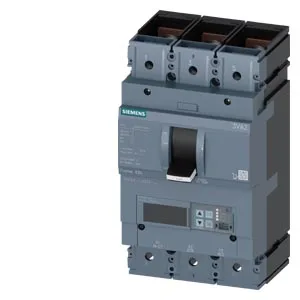
The Siemens 3VA2463-5JQ32-0DC0 is a SENTRON molded case circuit breaker (MCCB) designed for line protection, rated at 630 A full-scale with a minimum setting of 945 A and maximum of 5,670 A. It carries a 187 kA interrupting capacity at 240 V, 121 kA at 415 V and 440 V, and 75.6 kA at 500 V — numbers that define its fault-clearing muscle in distribution panels feeding transformer secondaries or heavy busways. At 690 V the interrupting rating drops to 9 kA, so if your line side runs 690 V, verify that the available fault current stays below that threshold.
Thermal Derating and Continuous Current
Above that, you derate: 600 A at 45 °C, 570 A at 50 °C, 540 A at 55 °C, 510 A at 60 °C, 480 A at 65 °C, and 450 A at 70 °C. That curve matters when the MCCB lives inside a crowded enclosure — if the panel ambient runs 50 °C, you only get 570 A continuous, not the nameplate 630 A. Plan your load budget against the actual cabinet temperature, not the catalog number.
It's a 3-pole unit designed for fixed mounting in a distribution panel — no DIN-rail snap-on here. The depth of 110 mm means it clears most standard enclosure back-panels, but verify gland-plate clearance if you're back-mounting against a rear wall. The auxiliary switch configuration is two HQ switches, and an undervoltage release (UVR) is integrated. A voltage-trip function is not standard, so if you need shunt-trip capability, that's a separate order.
Communication and Auxiliary Functions
This MCCB includes a communication function — it's not just a passive overcurrent protector. That means it can report status, trip events, and possibly current values back to a control system, depending on the communication module fitted. There is no separate voltage-trigger release (shunt trip) on this variant.