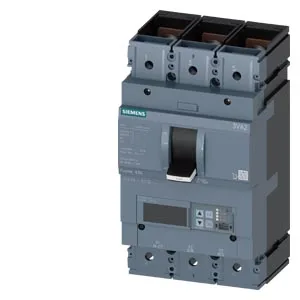
What this MCCB is and what the ratings mean for your panel
The Siemens SENTRON 3VA2463-5KP32-0BL0 is a 3-pole molded case circuit breaker (MCCB) rated for 630 A continuous current at 40 °C — that is the current it carries without tripping under normal conditions. The 630 A frame size is a fast mover for large feeder or main breaker applications in distribution panels. What matters for fit is the interrupting capacity: 187 kA at 240 V AC, 121 kA at 415 V and 440 V, 75.6 kA at 500 V, and 9 kA at 690 V. That 187 kA at 240 V means it can safely clear a fault up to 187,000 A without welding contacts or rupturing the case — critical for high-fault locations like transformer secondaries or large motor control centers. The breaker is designed for line protection (cable/feeder protection) and includes a built-in undervoltage release and a communication function for remote monitoring or trip indication.
Derating and thermal management — the real-world current rating
The 630 A rating holds only at 40 °C ambient. In a warm enclosure — common in food-and-beverage or furnace-adjacent panels — you must derate: 600 A at 45 °C, 570 A at 50 °C, 540 A at 55 °C, 510 A at 60 °C, 480 A at 65 °C, and 450 A at 70 °C. The maximum operating temperature is 70 °C, and the breaker dissipates up to 164.5 W at full load. That heat has to leave the enclosure; plan for ventilation or a larger cabinet if the ambient runs above 40 °C.
Physical fit and panel integration
Dimensions are 248 mm high, 138 mm wide, and 110 mm deep. The 138 mm width is standard for a 3-pole MCCB in this class — it fits typical Siemens SENTRON mounting feet and busbar systems. The 110 mm depth (4.33 in) is shallow enough for most 600 mm deep enclosures, but check gland-plate clearance if you are back-paneling with deep cable lugs. The breaker ships with a basic switch (order code 3VA2463-5KP32-0AA0) and comes configured with 2 auxiliary switches, 1 trip alarm switch, and 1 electrical alarm switch — that covers remote status and trip indication without adding extra modules.
