What this part does on a drive output
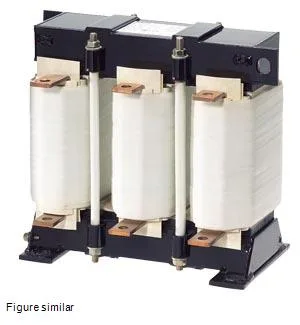
The Siemens SIDAC 4EU4521-0BW00-0B is a 3-phase output reactor (choke) rated for 200 A continuous, with 0.4 mH inductance and 3.2 kHz switching frequency. It sits between a variable-frequency drive and the motor to limit the rate of voltage rise (dV/dt) from the drive's PWM output, protecting motor winding insulation from reflected-wave damage on long cable runs. The 17.3% impedance (UK) at the rated condition gives a meaningful voltage drop that smooths the motor terminal waveform. Rated for 40 °C ambient with Class H insulation (180 °C thermal class per IEC 60085), so it handles sustained motor current without derating in a warm cabinet — a common pain point when a reactor is undersized for the enclosure's internal temperature.
Mounting and integration — IP00 open-frame
The flat-type terminals (flat connector) suit bus-bar or large-gauge cable connection typical of a 200 A power path. Dimensions: 0.46 m wide × 0.43 m high × 0.29 m deep. Plan for adequate clearance around the magnetic core for airflow and heat dissipation. The 470 Hz minimum operating frequency indicates this reactor is for PWM drive output, not line-frequency use.
Sizing check — does it fit your drive?
The 200 A continuous rating matches a drive output in that current class — typically a 90–110 kW (120–150 HP) 400 V drive depending on the motor's full-load amps. The 0.4 mH inductance and 3.2 kHz switching frequency are tuned for that power band. If your drive's carrier frequency is higher (4–8 kHz common on smaller drives), the reactor's core losses increase; verify thermal performance at your actual switching frequency against the datasheet's derating curve. The flat-type terminals accept bus-bar or large cable lugs. No DIN-rail mounting — this is a bolted-down chassis component. Plan for structural support in the panel.