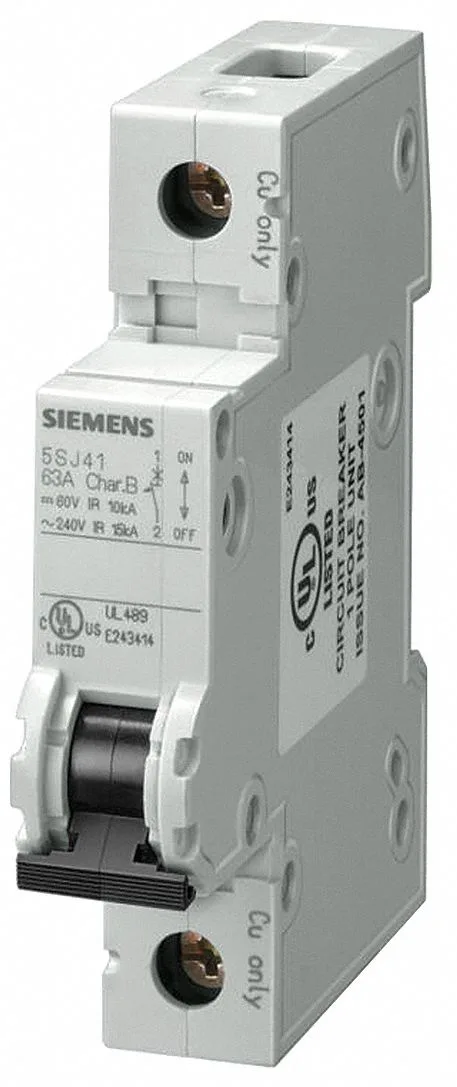
Rated breaking capacity is 10 kA per EN 60898 and 15 kA per IEC 60947-2 at 400 VAC, so it handles typical utility-side fault levels in commercial and light industrial installations. Insulation voltage is 440 VAC, giving headroom above the 400 V working voltage. IP20 with conductors connected, IP40 in the handle area — fine for enclosed panels, not for washdown zones.
The C-curve (tripping characteristic class C) is the deciding factor for most buyers: it allows short inrush spikes up to 10x rated current without nuisance tripping, making it the go-to for general-purpose motor circuits, fluorescent lighting, and small transformers. If your load is purely resistive (heaters, incandescent) a B-curve would be tighter; if it's high-inrush (large motors, welding gear) a D-curve might be needed. The 10 kA / 15 kA breaking capacity covers the vast majority of 400 VAC commercial installations — only high-fault locations (near large transformers) would require a higher-rated unit. DC rating is 60 V maximum, so it can be used on 48 VDC control circuits but not on typical 110 VDC or 125 VDC battery banks. The 1-pole design switches line only; neutral is not switched.