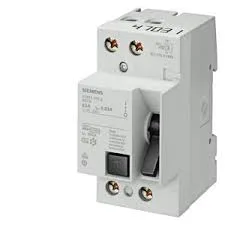
The Siemens 5SM3617-8 is a 2-pole residual current circuit breaker (RCCB) from the SENTRON 5SM3 series, rated 80 A at 230 V AC with a 300 mA residual trip threshold. It's a Type A selective design — meaning it's built to discriminate from downstream RCCBs, so only the faulted branch trips and the rest of the distribution board stays live. That selectivity is the whole point: you don't want a ground fault on a lighting circuit taking out the whole panel. The 300 mA trip threshold is sized for equipment protection or circuits with high leakage from long cable runs or VFDs. Mounts on a DIN rail (REG), takes 2.5 width units (45 mm of rail space), and accepts conductors from 1.5 to 25 mm² solid or stranded.
The 70 mm depth and 90 mm height are standard for this class of DIN-rail device. Supply can come from top or bottom, which gives flexibility in busbar routing. The 2.5 width units (45 mm) mean it occupies two and a half 18 mm module slots. Plan your rail fill accordingly — it's wider than a standard single-pole MCB but narrower than a 4-pole RCCB. The silicon-free construction is relevant for potting or conformal coating processes in sensitive environments.
How the ratings drive the decision
The 300 mA residual trip is selective: it's deliberately slower and higher than downstream 30 mA RCCBs, so a small leakage on a socket circuit trips the local device, not this one. The 5 kA surge current resistance means it can withstand transient overvoltages from switching or lightning without nuisance tripping. Type A detection means it catches both sinusoidal AC fault currents and pulsating DC fault currents — the kind you get from rectifiers, switching power supplies, or single-phase VFDs. That's the minimum type for modern commercial panels where electronics are present.