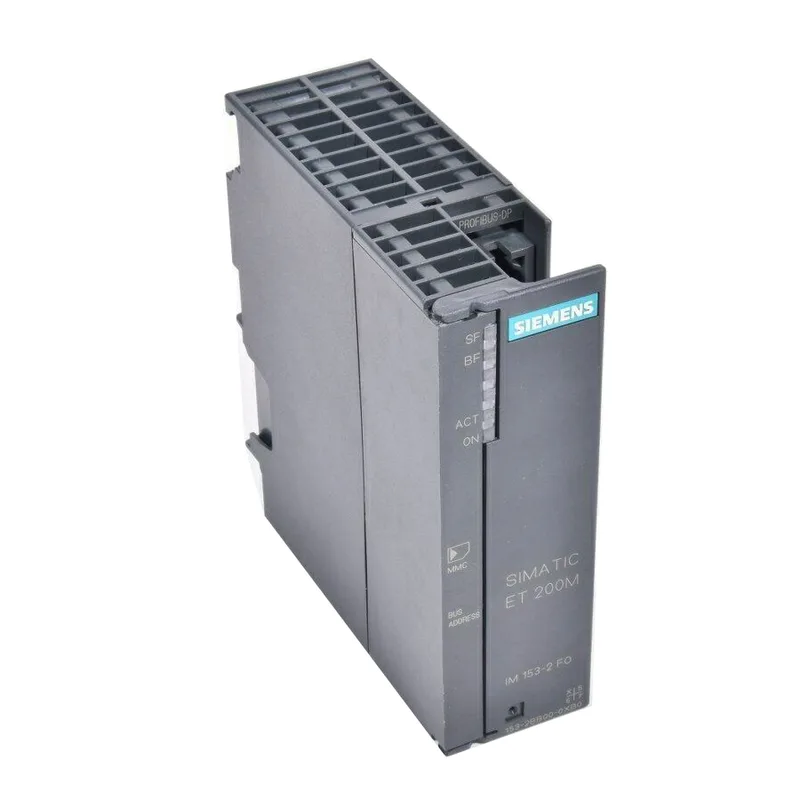
Diagnostics, time stamping, and message buffering
Time stamping on signal change is configured per digital input on rising and falling edges, with a time resolution of 1 ms and the date/time stamp formatted as RFC 1119 Internet time, so any PLC consuming the buffer does so on a deterministic 1 ms grid rather than polling jitter. Accuracy of the time stamp is 10 ms across the segment, with 3 ms available as the tighter figure on segments that meet the rated electrical environment. The IM holds 15 message buffers, with up to 20 messages per buffer, and transmits the buffer at a 1 000 ms time interval whenever a message is queued, which sets the bandwidth and memory budget a planner should leave for diagnostics on the same DP line. Up to 128 digital inputs per station can be time-stamped, and the station frame carries 128 bytes in / 128 bytes out for cyclic data — enough to drive a fat ET 200M on a single DP segment without splitting across two slaves.
Power, backplane, and panel-side budget
The IM runs on a 5 V DC rated supply on the backplane, drawing up to 500 mA at 24 V DC from the host, with an inrush current of 3.5 A typical and a stored energy time of 5 ms across mains/voltage failure, so the cabinet 24 V feed must hold the unit through a 5 ms dip without a brown-out reset. Backplane bus (5 V DC) draw is capped at 1 A maximum, and the permissible 24 V DC supply range is 20.4 V to 28.8 V, which sets the tolerance band a 24 V power supply needs to ride out under load steps. Typical power loss is 4.5 W, so thermal planning inside the cabinet is dominated by this dissipation plus whatever S7-300 modules sit behind it in the eight-module frame, not by the IM in isolation. No external protection for the power supply lines is recommended on this entry, so planners should not over-spec a breaker ahead of the IM; isolation between PROFIBUS and the internal bus is provided and tested at 500 V.
Footprint, environment, and what to derate
The module is 40 mm W x 125 mm H x 117 mm D, IP20, intended for cabinet mounting, so on a populated ET 200M rack it occupies one standard slot. Operating range is 0 °C to 60 °C ambient, with installation altitude capped at 3 000 m above sea level; above 60 °C the rated output is not guaranteed, which is the thermal ceiling a panel-builder should derate against in a sealed cabinet. The I²t value on the part is 0.1 A²·s, a diagnostic-energy rating that travels with the IM on the PROFIBUS segment and is independent of the 4.5 W thermal dissipation above.
Configuring it on the network
STEP 7 configures the IM natively, with COM PROFIBUS and non-Siemens tools able to integrate it through the GSD file — SIEM8071.GSD carries the DPV1-capable profile, while SI018071.GSG is the older IM 153-2AB0x support package and SI028071.GSG covers the IM 153-2BB0x variants including this one.