What this CPU brings to a control panel
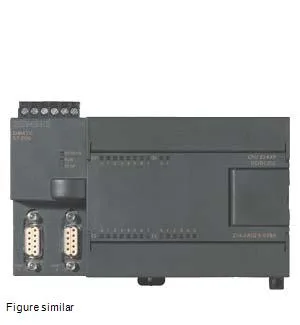
The Siemens 6ES7214-2AS23-0XB0 is an S7-200 CPU 224 with DC supply, DC inputs, and DC transistor outputs — the DC/DC/DC variant. It runs on 24 V DC (permissible range 15.4 to 28.8 V) and draws a typical 8 W power loss. The 14 onboard digital inputs (sink/source configurable per group) and 10 transistor outputs give you a compact machine controller that expands to 256 I/O points via the expansion bus.
Programming and protocol support
The CPU supports all three IEC 61131-3 programming languages for the S7-200 family: LAD (ladder), FBD (function block diagram), and STL (statement list). For networking, it has an integrated RS 485 interface that runs PPI protocol for programming and HMI communication (TD 200, OP) and MPI protocol for data exchange with S7-300/S7-400 CPUs, OPs, and TDs. Transmission rates are 9.6/19.2/187.5 kbit/s for PPI and 19.2/187.5 kbit/s for MPI.
Memory and retentive data handling
The entire program is stored maintenance-free on integral EEPROM, programmable via the CPU. Data blocks (DB 1) are loaded from PG/PC to EEPROM, with current values held in RAM. Retentive memory bits, timers, and counters are backed by a high-performance capacitor (minimum 70 h at 40 °C, max 100 h); an optional battery module extends this to 200 days typical. The retentive memory size is 32 bytes.
High-speed counting and pulse outputs
Six high-speed counters are built in: two counters handle up to 200 kHz, four handle up to 30 kHz, all 32-bit including sign. They can be used as up/down counters or for connecting incremental encoders with two pulse trains offset by 90° (A/B counters up to 100 kHz and 20 kHz respectively). Parameterizable enable and reset inputs, plus interrupt facilities when setpoints are reached. The two pulse outputs (Q 0.0 and Q 0.1) switch from 0 to 1 in 0.5 µs and from 1 to 0 in 1.5 µs, suitable for high-speed pulse train applications.
Input characteristics and wiring
Digital inputs accept 2-wire sensors. For signal '0', the voltage range is 0 V to 5 V (0 V to 1 V for I0.3 to I0.5). For signal '1', the minimum is 15 V (4 V for I0.3 to I0.5). Inputs are configurable as source or sink per group. The CPU also supports uprating — meaning you can expand I/O beyond the base unit with expansion modules.
Timers and program cycle
The timer suite includes 4 timers with 1 ms to 30 s range, 16 timers with 10 ms to 5 min range, and 236 timers with 100 ms to 54 min range. The command set covers bit logic, compare, timer, counter, clock, transmission, table, logic, shift/rotate, conversion, program control, interrupt, communications, logic stack, integer math, floating-point math, and numerical functions. Program processing runs free cycle (OB 1), interrupt-controlled, or time-controlled (1 to 255 ms).