Speed and torque across supply voltages
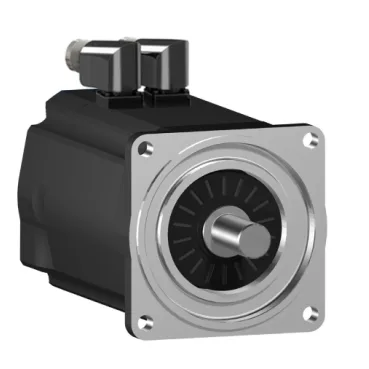
The SH31402P02F2100: This SH3-series servo motor delivers different nominal speeds depending on the supply: 750 rpm at 115 V single phase, 1500 rpm at 230 V single phase, 3000 rpm at 400 V three phase, and 3600 rpm at 480 V three phase. That speed spread means the same motor frame covers both low-speed high-torque and high-speed applications — but the drive must be configured for the actual line voltage or the motor won't reach its rated speed. Nominal torque also shifts with voltage: 164.6 lbf.in (18.6 N.m) at 115 V single phase drops to 85.9 lbf.in (9.7 N.m) at 480 V three phase. The continuous stall torque across the three-phase range is 172.6 lbf.in (19.5 N.m), so the motor holds its low-speed torque capability even at higher line voltages — useful for positioning stages that need consistent breakaway force.
Built-in holding brake and encoder feedback
Feedback comes from an absolute multiturn SinCos Hiperface encoder, which means the drive knows the rotor position at power-up without a homing cycle. That saves time on multi-axis machines where each axis would otherwise need to find its reference on every restart.
Environmental sealing and mechanical interface
Both the motor body and the shaft bushing carry IP65 protection per IEC 60034-5, so the unit withstands washdown and dust ingress in food processing or machining environments. The smooth shaft (no keyway) and 0.9 in (24 mm) diameter with 2.0 in (50 mm) shaft length mate with a clamp-style coupling — verify the coupling bore matches before assembly. Mounting uses an international standard flange with a 5.5 in (140 mm) flange size and 5.1 in (130 mm) centring collar diameter. The four mounting holes are 0.4 in (11 mm) diameter on a centring collar depth of 0.1 in (3.5 mm) — standard B5 or B14 flange pattern, so it swaps into existing mounting footprints without adapter plates.
Electrical parameters and cooling
Stator resistance is 0.6 Ohm and inductance is 3.855 mH — the time constant (L/R) is about 6.4 ms, which sets the current-loop bandwidth ceiling for the drive. The torque constant is 1.47 N.m/A at 248 °F (120 °C), and the back EMF constant is 101 V/krpm at 68 °F (20 °C), so the drive's DC bus voltage must be high enough to overcome back EMF at top speed. Cooling is natural convection — no external fan or water jacket. The maximum current Irms is 44.1 A, with a 3-second peak of the same value, so the motor can deliver short bursts of peak stall torque (531.9 lbf.in / 60.1 N.m) for acceleration moves, but the RMS current must stay within the continuous rating for thermal stability.