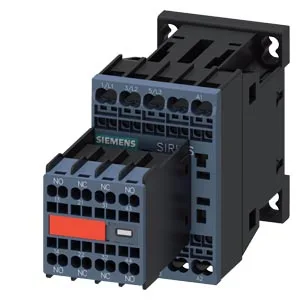
The 24 VDC coil with spring-type terminals means no screw tightening — strip the wire, push it in, and the cage clamps it. Rated for AC-3 duty at 750 operating cycles per hour, this contactor handles typical three-phase motor starts without excessive wear on the contacts. Mounts via screw or snap-on onto 35 mm DIN rail per DIN EN 60715, with a compact footprint of 45 mm wide, 70 mm high, and 121 mm deep — fits standard panel spacing without crowding adjacent devices.
The AC-3 switching frequency of 750 cycles/h is the practical limit for motor starting under load — exceeding it accelerates contact wear. For resistive loads (AC-1), the contactor can cycle up to 1 000 times per hour. DC breaking capability is specified per voltage: 6 A at 24 V, 2 A at 48 V and 60 V, 1 A at 110 V, 0.9 A at 125 V, and 3 A at 400 V. These are not AC ratings — DC arcs are harder to extinguish, so the current limits drop as voltage rises. If your circuit is DC, match the voltage column exactly.
Wiring and integration
Spring-type terminals accept solid or stranded conductors from 0.5 to 4 mm², or 2 x (0.5 to 4 mm²) for looping through. No screwdriver needed for the power side — strip to the right length and push in. That's the minimum air gap to adjacent metalwork or live parts. This variant ships without an auxiliary switch block. If you need feedback contacts for the PLC or status indication, an auxiliary switch block (side-mounted) must be ordered separately and snaps onto the contactor's side slots.