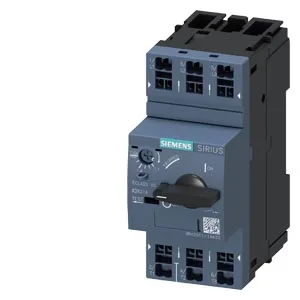
Dimensions are 97 mm deep, 45 mm wide, 106 mm tall — fits a standard motor-starter footprint. Clearance: 50 mm above and below, 30 mm to the side, nothing in front or back.
The 100 kA breaking capacity at 400 V AC (and at 240 V, 500 V, 690 V) means this breaker can be used on high-fault-capacity panels without cascading coordination issues upstream. The CLASS 10 trip class is the standard for general-purpose motor starting — it lets the motor draw starting current for about 10 seconds before the thermal element trips, which covers most pump, fan, and conveyor starts. If you're protecting a high-inertia load that needs a longer start, you'd want a CLASS 20 or CLASS 30 trip instead. Compared to the 3RV1011-0GA10 (a similar SIRIUS motor-protective breaker), the 3RV2011-1AA20 shares the same DIN-rail footprint and CLASS 10 trip, but the 3RV1011-0GA10 has a lower breaking capacity. No rewiring required for a swap — same terminal layout and mounting.