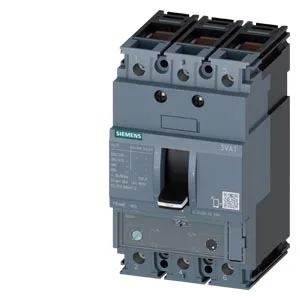
The Siemens SENTRON 3VA1110-6EF36-0KA0 is a 3-pole molded case circuit breaker (MCCB) rated 100 A at 40 °C, with a TM240 thermal-magnetic overcurrent release and an integrated shunt trip (STL). The 100 A rating holds flat through 50 °C — no derating needed in a typical 40 °C panel — then steps down to 98 A at 55 °C and 91 A at 70 °C, so if the breaker sits near a heat source or in a crowded enclosure, use the 70 °C column for your continuous-load calculation. The breaking capacity is the headline: 220 kA at 240 V, 154 kA at 415 V, 121 kA at 440 V, and 17 kA at 500 V and 690 V. At 690 V the 17 kA rating still covers most industrial motor-control centers.
The breaker measures 130 mm high, 76.2 mm wide, and 70 mm deep — a standard 3-pole MCCB footprint that fits most DIN-rail or panel-mount enclosures without surprises.
The basic switch supplied is order code 3VA11106EF360AA0 — that is the breaker mechanism itself. The shunt trip (STL) is integrated. No undervoltage release, no ground-fault module, no communication module. The kit is complete for a line-protection MCCB with shunt trip; the tech won't be stranded mid-job for a missing accessory, but if you need undervoltage release or ground-fault monitoring, this variant does not carry them.